Free · Uzbekistan
Your Train Ticket: Check More Than the City Name
A practical ticket check to make after booking, before planning your way to the train.
A visitor planning to go from Tashkent to Samarkand may feel finished once the search result shows the two city names. But a city pair is only a start. The useful details are the actual departure station, departure date and local time, train, passenger identity, issued ticket and the route from the arrival station to the next place you will stay. Without those, you have a plan for a journey rather than all the information you need to take it.
Uzbekistan Railways provides an official English-facing e-ticket portal with route searches, timetables and a ticket-authenticity check; the passenger operator also publishes station information and a timetable section. Both are more useful as current references than a screenshot from somebody else's earlier trip. [1–3]
The practical result: Before you travel to a station, compare six things against your real ticket or the official booking record. Do not use a bank transaction notification or an email from an unknown seller as your only proof that a valid ticket was issued.
1. Begin with the official booking record, not a search result
The official passenger e-ticket portal is https://eticket.railway.uz/en/. Its public page offers a search by origin, destination and date and includes an option labelled Check ticket authenticity. The authenticity section offers routes using a ticket number or passport and date. Those are the operator's own interface labels as checked on 23 October 2026. The site and payment process may change. [1]
A screenshot of a train search is not itself a ticket. An itinerary selected in a shopping basket is not necessarily an issued reservation. An authorization on a foreign bank card is a payment event, not automatic proof that the railway's system generated a valid passenger ticket. Keep the message from the actual seller, but also find the issued e-ticket and its number through the authorized booking channel.
If you booked through a travel company, ask which operator or issuing agent provided the ticket and how to verify it. A paid agent can help; a travel-company reference may be separate from the railway's own electronic ticket number. Do not assume a third-party reference will work in the official ticket-authenticity field.
If the process stops at payment: First check the actual ticket record and your transaction before beginning another payment. Use the official railway's help channels if the result remains unclear. This article does not promise that a particular foreign card, payment option or booking window works for every visitor. [1, 2]
2. Read six fields together
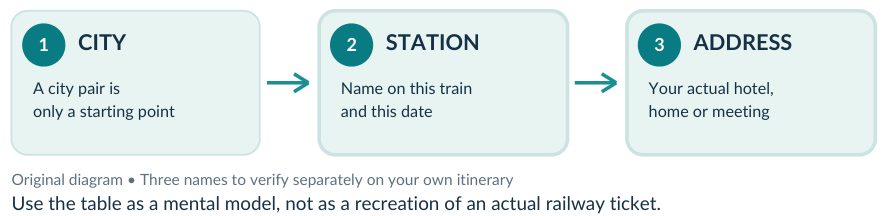
Use the table as a mental model, not as a recreation of an actual railway ticket.
| Check | What to compare | Why it matters |
|---|---|---|
| 1. From station | Exact boarding station on the issued ticket | The name of the city alone may not identify the place where your train boards. |
| 2. To station | Actual station where this train terminates your booked segment | Reaching the advertised region is not the same as arriving at your hotel. |
| 3. Travel date and time | The departure date, clock time and any date change | A late-night or early-morning journey can fall on a different calendar day from your hotel plan. |
| 4. Train and accommodation | Train identifier, service type, class/carriage and any allotted place shown | Two trains to the same city are not interchangeable reservations. |
| 5. Passenger and ticket | Name and required identity details, issued ticket number and authenticity | A ticket for someone else or an incomplete issue is not a safe basis for boarding. |
| 6. Arrival connection | Station-to-hotel route and way to contact your host | A correct ticket can still leave an unplanned last leg. |
The city suggestions on the official portal include, for example, Tashkent, Samarkand, Bukhara, Khiva and Urgench. These are route-search labels, not proof that every city name maps to one station or that every pair has a direct service on your date. Use the station named on the actual issued itinerary, and check that station's current address independently. [1]
Station names deserve a second look. The passenger operator has used the station designation Toshkent-Markaziy in its own communications. This illustrates why "Tashkent" as a city label should not be treated as the complete station name on a specific ticket. It does not establish that your service departs there. [2]
You may also see names written differently between English and Uzbek-language interfaces. For example, Tashkent/Toshkent, Samarkand/Samarqand and Bukhara/Buxoro can refer to the same cities in different writing conventions. But matching transliterations does not replace confirming the exact station displayed in your own booking. If in doubt, copy the ticket's original station wording to the operator, hotel or transport provider and ask them to confirm the boarding entrance.
3. Three fictional journeys: three different mistakes to avoid
All travellers, ticket fragments and timings in these examples are invented for teaching. They are not real reservations or official ticket images. No passenger number or barcode in this guide can be used for boarding.
Case A: Elena knows the cities but not the platform-side station
Elena bought a seat between Tashkent and Samarkand. Her accommodation host messages: "Leave the hotel at 7:30; the train is at 8:30." Elena notices that the host gave a city and a time, not the station printed on the booking.
She checks her issued ticket, copies the precise station designation and asks the hotel to confirm the correct station entrance and realistic transfer time. She plans for the additional time required to reach the station and follow any current boarding directions. She does not assume a different railway building with a similar city name is interchangeable.
Lesson: A hotel transfer is not planned until the exact station on the ticket has been checked.
Case B: A family booked a connection to Khiva, but what about Urgench?
Rahim and Sofia want to visit Khiva. A trip-planning website presents options mentioning both Khiva and Urgench. The official railway portal offers both as selectable destination labels. [1]
They do not infer that the two words mean the same destination. They compare the actual station on the issued ticket with the address of their Khiva accommodation, then plan the final transfer. One option may suit the next day better even if another looks simpler in the initial search. They do not invent a fixed travel time or guarantee that a particular service is available.
Lesson: The correct route is the route that takes you from your actual arrival station to your actual next accommodation.
Case C: A near-midnight departure and two different calendar dates
A fictional traveller, Priya, is leaving late in the evening and will arrive after midnight. She initially writes the arrival date as the train's departure date. Before arranging a pickup she checks the issued ticket's departure day, departure clock time and arrival information separately. She confirms with the accommodation host using both the written date and the day of the week.
Her hotel booking, train departure and planned pickup must refer to the same real trip, not just look similar in a calendar app. She saves the booking offline and keeps the original identity document she is required to present.
Lesson: A train reservation date, hotel check-in date and arrival date may be different fields. Check all three instead of guessing.
4. Verify the ticket without making a copy that looks official
The operator's e-ticket portal publicly provides a ticket-authenticity check. Its displayed inputs include a ticket-number route and a passport-and-date route. Use the live official page for the current method rather than copying a sample from this article. [1]
A sensible sequence is:
- Open the railway's own English-facing e-ticket portal from a saved official address, not an unfamiliar link in a social post.
- Locate the issued e-ticket number in the ticket provided by your authorized seller or booking account. Do not confuse it with a train number, a payment transaction number or a travel company's internal order reference.
- Use the official authenticity function if it is available for your kind of issued ticket. Compare the result with the passenger and itinerary information you were given.
- If the system returns no match, an error or a record you do not recognize, do not edit the passenger identity, guess a random number format or purchase again just to force a different result. Confirm details with the authorized seller or the official railway support channel.
- Keep a private, offline copy of your genuine ticket and any required identification. Do not publicly post a usable ticket number, passport details or screenshots containing personal data.
The official e-ticket portal prominently warns that a fake ticket or a ticket belonging to someone else is not valid for boarding. This warning is visible on the public portal, without making a booking or entering personal data. This article therefore uses descriptions and invented scenarios, not visual replicas of usable railway tickets. [1]
5. Separate the station, train and onward transfer
An issued train ticket may settle the railway leg while leaving the surrounding journey unfinished. Ask these questions in order:
Which station must I reach? Find its exact name as printed on the ticket. Consult the operator's current station/timetable pages and, when relevant, ask the accommodation host to confirm the location. The operator maintains station information separate from general city searching. [2, 3]
How much time do I need to get there? Estimate your own transfer with traffic, luggage and check-in requirements in mind. Check the railway's current boarding instructions. This article intentionally does not invent one national "arrive X minutes early" rule.
Which train am I allowed to take? Compare the actual train/date/class or seat information on the ticket with the service you plan to board. If a timetable changes, recheck the issued record or operator notice rather than assuming the next train to the same city is acceptable.
Where will I go after getting off? Save your hotel's exact address and a way to contact the host. When you choose an arrival station, account for the final transfer before calling the journey finished.
What if something changed? A train displayed as available in a general search may not be the same as your ticketed service. A seller may have separate change and refund procedures. Do not assume you can move a ticket between trains, names or dates without an operator-approved change. Consult the actual conditions tied to the issued ticket. [1, 2]
6. The five-minute check to keep on your phone
Copy these six short prompts into a private note before departure:
- Issued ticket? I can see a real ticket number from the authorized seller/railway, not merely a payment or a search result.
- Right stations? I have the exact boarding and arrival stations, not just the two city names.
- Right trip? My train, departure date/time, accommodation and passenger details agree.
- Verified? I know where to use the official authenticity function if my ticket or seller information looks wrong.
- Station transfer? I know how to reach the correct departure station and how to get from the arrival station to the next address.
- Private and ready? My ticket and required original identity document are secure and available offline; I have official support information if something changes.
The one-sentence rule: A city pair tells you where you hope to go. An issued, verified ticket with the correct station, date and passenger details tells you what journey you actually have.
Official sources and editorial scope
Checked 23 October 2026. No live reservation, paid ticket, actual station boarding, international card purchase or ticket-authenticity lookup for a real passenger was completed during preparation. All names and scenarios are fictional. Station locations, train services, ticket conditions and payment availability may change; check the operator's current details for your own date and booking.
- Uzbekistan Railways — official English e-ticket portal: https://eticket.railway.uz/en/ — shows search by route/date, a destination list, and a ticket-authenticity interface labelled Ticket number / Passport and date. Public interface checked 23 October 2026; no live search/checkout performed.
- O'ZTEMIRYO'LYO'LOVCHI — passenger operator: https://uzrailpass.uz/ — operator's pages for timetables, passenger information and stations; its published 2025 communications use Toshkent-Markaziy station wording. Site checked 23 October 2026. The home page also provides passenger contact details; verify the current details there rather than treating old lists as permanent.
- Passenger-operator station information: https://uzrailpass.uz/pages/spravocnik — public station enquiry list including Tashkent, Samarkand, Bukhara, Urgench and others. Check current pages for contact or location before depending on any number.
- Uzbekistan Railways — official railway organization portal: https://railway.uz/en/ — operator and service context; do not treat general promotional routes as live availability for a given date.
Location references
These Google Maps searches identify the places discussed here. Confirm the exact address and current access separately.